
Showing posts with label plantain. Show all posts

Wednesday, January 22, 2014

Giant strides in IITA plantain breeding for West Africa

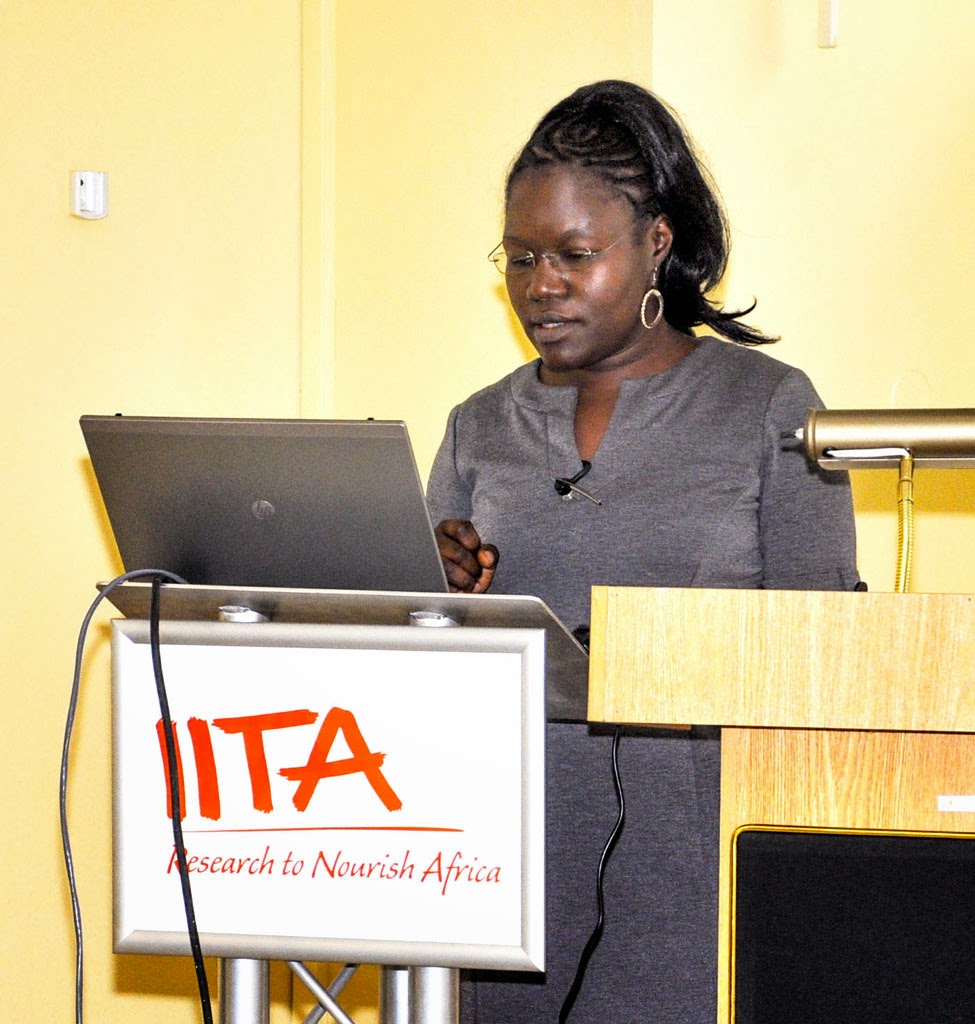
Amah during her contract review seminar
IITA has made significant progress in its plantain research in West Africa with the generation of seedlings from crosses with in vitro induced tetraploids from diploids―a first for the Institute.

The IITA Regional Banana Breeding Manager, Delphine Amah, who supervised execution of the crosses in IITA-Ibadan, said the crosses were vital for plantain improvement in West Africa in the years ahead.

Delivering her contract review seminar titled: Support to Banana and Plantain Breeding―Updates on West Africa, Amah said the Banana Unit had recorded giant strides in the recent years.

For instance, as part of a revised pre-breeding strategy to produce improved parents while shortening the breeding cycle for plantain, the unit was now producing tetraploids which have four sets of chromosomes from diploids (which have two) using optimized in vitro doubling techniques.

In addition, tissue culture techniques have been employed to generate seedlings from crosses through embryo culture and mass propagation of plants for clonal evaluation.

The unit is also promoting the use of macropropagation and field propagation techniques for the production of clean planting material and good agronomy practices.

So far, Amah and her team have produced and distributed thousands of Agbagba plantain plantlets to the IITA farm unit and Youth Agripreneur project for propagation and distribution.

Furthermore, they have established pollination blocks with female fertile plantain landraces and Black Sigatoka resistant tetraploid plantain hybrids for accelerated breeding.

The team has established recently imported Musa acuminata ssp. banksii accessions for evaluation and use as parents in crosses to breed for plantains with high provitamin A content.

They have also established a propagation scheme for the production of plantlets for pollination blocks and planned trials to enable registration of new IITA hybrids.

All these activities are aimed at rejuvenating plantain breeding in IITA for efficient delivery of improved varieties to farmers, she said.

Thursday, September 12, 2013

One year of IITA Youth Agripreneurs

IITA Agripreneurs in their cassava field

The IITA Youth Agripreneurs are a group of young graduates involved in agribusiness, with the aim of being a unit that would serve as a model to other young people planning to venture into agribusiness and becoming the trainer of trainers. Within one year of their existence, they have established many hectares of maize, cassava, and soybean and also plantain/banana fields. They have also multiplied plantain suckers in the macropropagation chamber. They have managed to bridge the gender inequality gap in the team, with their present number standing at 11 men and 10 women.

The activities of the group cut across the value-chains of different crops including cassava, maize, plantain/banana, and soybean. For cassava, the Youth Agripreneurs  are into stem multiplication and root production. For maize and soybean, their focus is on seed multiplication (both certified and foundation seeds), whereas for the plantain/banana, they are into sucker multiplication and fruit production.

The uniqueness of the team lies in the heterogeneity of the disciplines inherent therein, ranging across the Arts, Sciences and Social Sciences. After a meeting with the IFAD President, Dr Kanayo Nwanze, intended to spur youth involvement towards sustainable agriculture, the members of the National Youth Service Corps who were then serving in IITA, Ibadan, under the guidance of the Director-General, Dr. Nteranya Sanginga, responded with enthusiasm to the call on 28 August 2012.

The project began with a series of activities, such as attending seminars and training within and outside the
Institute, including a workshop organized by UNIDO in Songhai. Visits to seed companies, most of them in the northern part of Nigeria, were also made. The project has had visitors from various organizations, USAID, UNIDO, FARA, NIPSS, etc., to mention a few.

The Agripreneurs look forward to collaborating with sponsors and investors, as one of their future plans is to expand their production. They wish to become self-independent and self-employed, having acquired the necessary knowledge and skills, and ultimately become employers of labour.

Agripreneurs trained on plantain/banana production

Youths during banana/plantain training
Members of the IITA Youth in Agriculture project have been trained on banana and plantain production. The training, which involved 11 members of the group, was held on 23 January, and cut across the value chain of banana/plantain with the following themes: Why invest in plantains/banana? Setting up plantain/ banana macro-propagation and field cultivation, pests and diseases affecting the crop, and how to control them. Plantain (Musa spp.) are the green, starchy cousins of the banana. Unlike banana, plantains are not sweet and are eaten cooked, rather than raw. Originating in Southeast Asia, plantains are now grown in subtropical and tropical regions around the world.

The macro propagation of plantains/banana is a relatively easy technique that is carried out in a shed. It consists of generating suckers from clean planting material by removing the apical dominance which will generate about 30-40 suckers between 3 months. These techniques are simple and therefore easy to grasp, and cheap to establish with minimum investment in construction of propagators and weaning facilities.