Saturday, August 17, 2013

Nigeria releases two extra-early maturing white maize hybrids

Farmer in extra-early maturing white maize field 
Nigeria has released two extra-early maturing maize hybrids with combined resistance/tolerance to Striga, drought, and low soil-nitrogen.
The extra-early hybrids, originally known as IITA Hybrid EEWH-21 and IITA Hybrid EEWH-26, are now designated Ife Maizehyb-5 and Ife Maizehyb-6. They were developed by the International Institute of Tropical Agriculture (IITA) and tested extensively in Nigeria in partnership with the Institute of Agricultural Research and Training (IAR&T) through the funding support of the Drought Tolerant Maize for Africa (DTMA) Project.
Other collaborating institutions involved in the testing include the Institute of Agricultural Research (IAR), the University of Ilorin (UNIILORIN), the University of Maiduguri (UNIMAID), and the National Centre for Genetic Resources and Biotechnology (NACGRAB). The DTMA Project is executed by CIMMYT and IITA in 13 countries in sub-Saharan Africa.
Both extra-early hybrids have desirable grain cooking characteristics and outstanding yield and stability across environments in Nigeria ravaged by drought, Striga, and low soil-nitrogen. The potential yield of Ife Maizehyb-5 in Nigeria is 6.0 t/ha and Ife Maizehyb-6 yields 5.5 t/ha. Local varieties yield about 1.5 t/ha.
Hybrid development and promotion is a promising strategy to appreciably increase maize production and productivity and to revolutionize agriculture in West and Central Africa (WCA). 
 “Seed companies and farmers in WCA have been asking for stress tolerant extra-early hybrids to reduce the instability of maize yields, especially in the savannas, as well as during the second season in the forest agroecological zone,” according to Dr Baffour Badu-Apraku, IITA Maize Breeder, who is also a member of the team that developed the hybrids.
Other researchers in the team are Drs S.A. Olakojo, G. Olaoye, M. Oyekunle, M.A.B. Fakorede, B.A. Ogunbodede, and S.E. Aladele.
This is the first report on the release of extra-early hybrids with combined resistance to Striga and with genes that confer tolerance to low soil-nitrogen and to drought stress at the most drought-sensitive stages (flowering and grain-filling periods).
 “The release of the two extra-early hybrids should contribute to a significant reduction in the instability of maize yields in Nigeria as well as in other countries of WCA,” Badu-Apraku added. The adoption and commercialization of these extra-early hybrids released in Nigeria and of others presently in the pipeline for release in Ghana, Mali, and Bénin should contribute significantly to food security and lead to improved incomes and livelihoods for farmers in WCA.

Friday, July 19, 2013

How Africa can feed Africa


IITA DG Sanginga speaking at the AASW in Accra
Efforts by Africans to feed themselves and escape the food importation trap and put the continent on the path to economic growth must give attention to soil fertility, according to the Director General of the International Institute of Tropical Agriculture (IITA), Dr Nteranya Sanginga. Addressing participants at the 6th Africa Agriculture Science Week organized by the Forum of Agriculture Research in Africa (FARA) in Accra, Dr Sanginga highlighted the impact of agricultural research over the years and concluded that Africa must adopt scientific innovations and pay attention to natural resource management to drive the agricultural development agenda.
“The issue of soil fertility must be addressed if Africa wants to feed itself,” he said today.
The IITA boss expressed optimism for Africa’s agricultural transformation, highlighting the increasing attention being paid to agriculture by governments on the continent.
However, he reiterated that efforts need to focus on restoring soil fertility, creating an enabling environment for market policies, and developing more resilient and productive farm systems.
He warned against policies that limit African researchers from taking advantage of modern technologies, stressing that such a move would deprive Africa from making progress and put the continent farther from the African Green Revolution.
The 6th Africa Agricultural Science Week provided an opportunity for Africans and partners to rethink the commitment by African governments 10 years ago which also led to the establishment of the Comprehensive Africa Agriculture Development Programme (CAADP).
CAADP focuses on improving food security, nutrition, and increasing incomes in Africa's largely farming based economies. It aims to do this by raising agricultural productivity by at least 6% per year and increasing public investment in agriculture to 10% of national budgets per year. So far, only a few countries have met the CAADP targets.
Dr Kanayo Nwanze, President of the International Fund for Agricultural Development (IFAD), said there is still a lot to be done in the context of the ever-changing and increasing challenges choking agricultural development in Africa.
He noted that the world is producing enough but that the food is not reaching those that need it most.
"We must put our efforts both in improving productivity and reducing postharvest losses," he added.
The IFAD President called for a paradigm shift in addressing food insecurity in Africa.
According to him, research and development need to be “repositioned” into research for development to bring the benefits of research to the farm. He advised scientists to ensure that their research is in consonance with the reality on ground and that it addresses the challenges of development in an empirical manner.

Thursday, July 18, 2013

How can Africa feed Africa?

Photos at AASW in Accra


IITA staff with Prof Lateef Sanni at the CGIAR booth
L-R: Dr Adekunle of FARA and DG Sanginga
L-R: Dr Papa Seck and DG Sanginga
L-R: Drs Sanginga, Papa Seck, and IFAD President, Dr Kanayo Nwanze
 
L-R: Dr Monty Jones, FARA Executive Director  and Dr Nteranya Sanginga, IITA DG, share
 thoughts on how Africa can feed Africa at the 6th Africa Agriculture Science Week in Accra 

Wednesday, July 17, 2013

Top international scientists recommend increase in public funding for cassava sector

Researchers at the IITA side event in Accra
International top-level scientists from the cassava world have urged African governments to increase public funding for the cassava sector. In the long-expected event “Productivity, Processes and People: Adding Value to Cassava” organized by the International Institute of Tropical Agriculture (IITA) on 16 July 2013 at the 6th African Agricultural Science Week in Accra, disease control, technology development in cassava processing, and women’s participation in cassava research were identified as priorities for boosting the sector’s impact on food security in Africa.
“Increasing funding for cassava research and processing across the value chain by including women in decision making roles is necessary for the future of the continent. It contributes to the creation of jobs for the youth, better livelihoods for smallholder farmers, reduction in hunger and poverty, and food security for all ”, says Dr Elizabeth Parkes from IITA.
Cassava in Africa is threatened by two devastating diseases, Cassava Brown Streak Disease (CBSD) and Cassava Mosaic Disease (CMD), leading to potential losses in food security and livelihoods of 135 million people in East Africa alone, and the 300 million cassava consumers in Africa as a whole.
Both diseases are caused by viruses and transmitted by small insects called whiteflies. New, super-abundant whiteflies have emerged in Uganda, spreading south and west, and are now present as far south as Zambia and as far west as Cameroon. The diseases are also spread by stem cuttings taken from infected plants. The international movement of these cuttings is increasing rapidly—within and beyond Africa—the diseases could spread to the rest of Africa and, possibly, the rest of the cassava-producing world. If CBSD reaches Nigeria—the world’s biggest producer and consumer of cassava—it could cause a human catastrophe of unforeseen magnitude.
Proper management of the crisis would allow cassava to develop its full potential for improving food security in Africa, not only as a subsistence crop, but also for generating income. “If Africa takes advantage of cassava and supports favorable policy frameworks and tax policies for the processing and marketing cassava and other crops, then we will more effectively tackle many problems in food security for the continent ,” Dr Parkes explained...Read more on www.iita.org

Farmers in twenty African countries get new window of opportunity to significantly increase yield


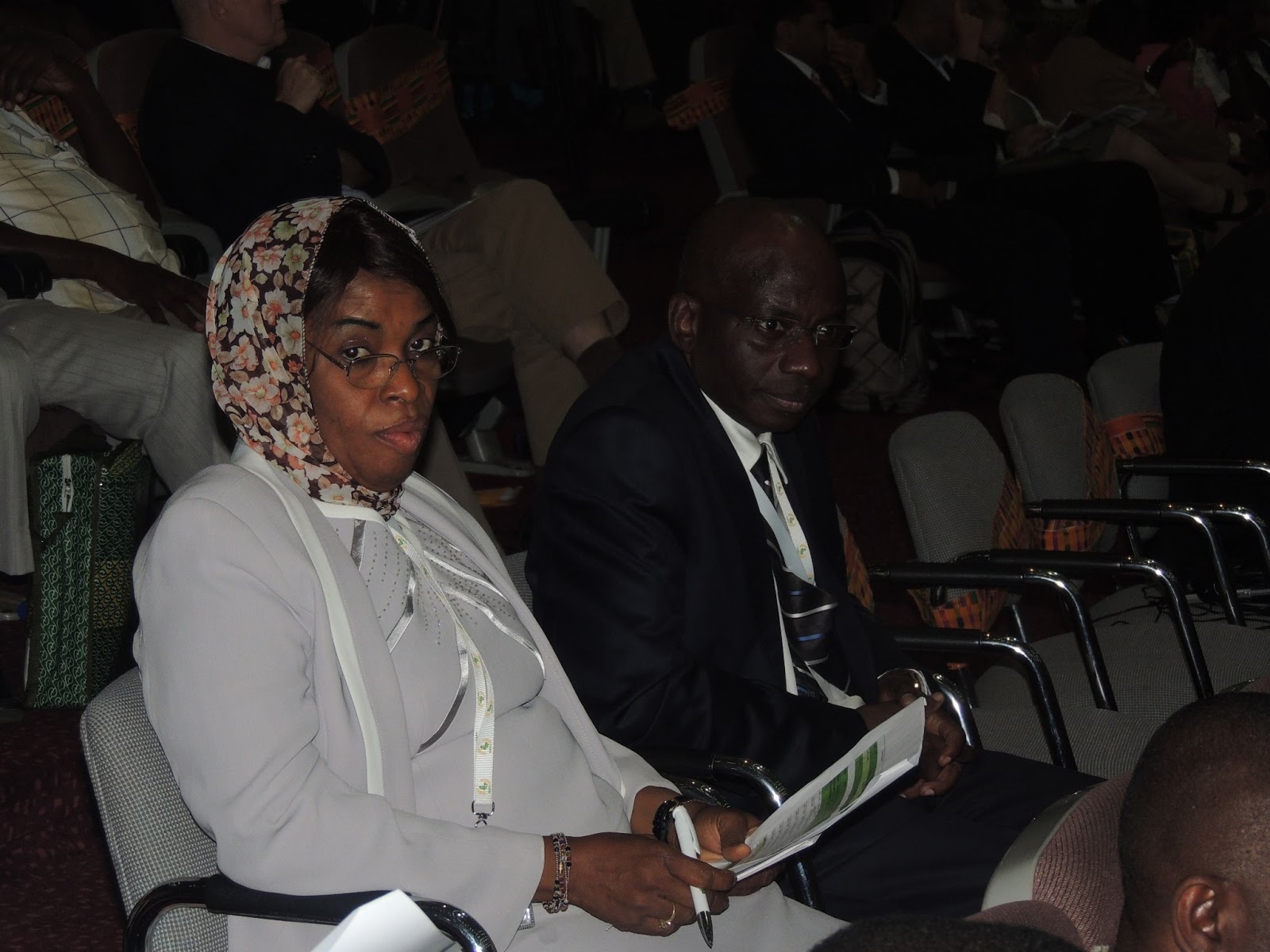
Participant at the SARD SC Side Event in Accra
Efforts to transform agriculture in Africa have received a boost as researchers met under the Support for Agricultural Research and Development of Strategic Crops (SARD-SC)’s event, “Partners, Possibilities and Prospects,” on 15 July 2013 at the 6th African Agricultural Science Week in Accra to draw more support from partners into project.
The SARD-SC project will raise the productivity of maize, cassava, wheat, and rice by 20% in twenty selected countries in Africa.
The plan is to reduce food importation from other continents and offer farmers better access to markets, improve livelihoods, and tackle poverty through enhanced capacities of beneficiaries to sustainable development in the region.
About a million farmers will directly benefit from the project through its innovations basket, while another million and half will be reached by project spin off effects. “Narrowing the yield gap is key for African farmers, and it will help them to compete globally and to feed themselves,” says Project Coordinator of SARD-SC, Dr Chrysantus Akem, from the International Institute of Tropical Agriculture (IITA).  
Funded by the African Development Bank with US$ 63.24 million, SARD-SC also aims to create knowledge on the tested innovations with farmers in Benin, Côte d’Ivoire, DR Congo, Eritrea, Ethiopia, Ghana, Kenya, Lesotho, Madagascar, Mali, Mauritania, Niger, Nigeria, Senegal, Sierra Leone, Sudan, Tanzania, Uganda, Zambia, and Zimbabwe.
Drs Thomas Dubois, SARD SC Rice Commodity Specialist; and Solomon Assefa, SARD SC Wheat Commodity Specialist made presentations on rice and wheat strategies of the project.
The 5-year, multi-CGIAR center initiative will run until 2016, and will be co-implemented by three Africa-based CGIAR centers: IITA, Africa Rice Center, and the International Center for Agricultural Research in the Dry Areas. IITA is also the Executing Agency of the project. Another CGIAR center – the International Food Policy Research Institute – a specialized technical agency, will support the other three centers. ###
For more information, please contact: Godwin Atser, g.atser@cgiar.org; Chrysantus Akem, c.akem@iita.org  or Andrea Gros, a.gros@cgiar.org